

Scientists Built a Cell-Like System From Scratch.
The Real Breakthrough Is Chemistry Learning the Cell Cycle.

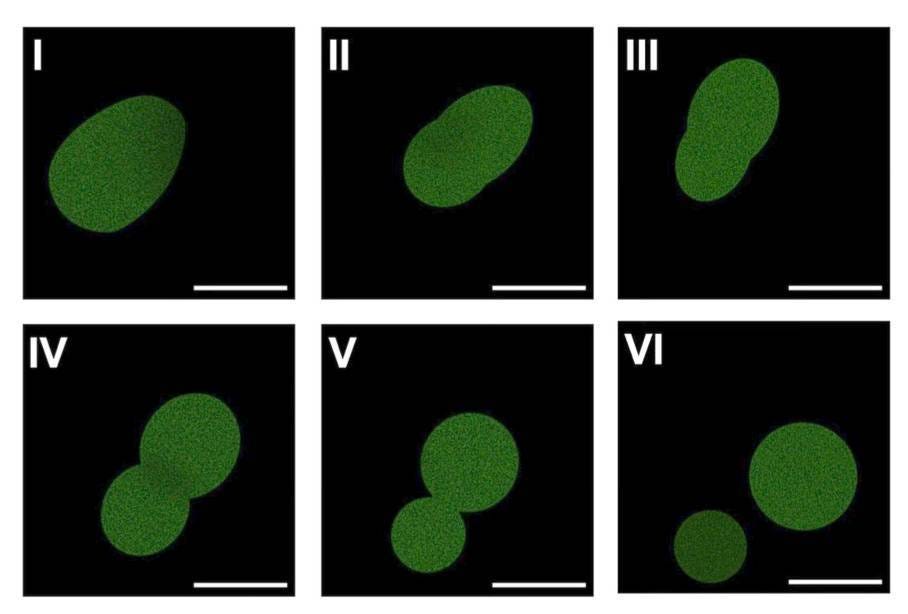
Scientists have reported one of the most important synthetic-biology milestones yet: a chemically defined, cell-like system that can feed, grow, copy its DNA, divide, and show selection across generations.
The system is called SpudCell.
The viral headline almost writes itself:
Scientists created life from scratch.
But the scientifically stronger version is more precise:
Scientists built a bottom-up synthetic cell-like system from nonliving components that reconstructs several core behaviors of cellular life.
That distinction matters.
SpudCell is not a bacterium. It is not fully autonomous life. It does not survive indefinitely, manufacture all of its own machinery, or reproduce with the reliability of natural cells. But it is still extraordinary because it connects several life-like processes inside one engineered chemical system: resource acquisition, growth, genome replication, gene expression, division, selection, and competition.
The manuscript describes a chemically defined synthetic cell encoded by a roughly 90kb genome, with functions for resource uptake, transcription, translation, growth, genome replication, and division. It also frames the central challenge clearly: not merely putting molecules inside a membrane, but coupling growth and division to gene expression.
Biotic describes SpudCell as a system built from known chemical components, containing purified enzymes, a 90,000-base-pair genome, and a lipid membrane, able to grow, replicate its genome, divide, and undergo selection and competition across multiple generations. (biotic.org)
That is the real milestone.
Not “life created.”
Something more careful, and arguably more profound:
A defined chemical system is beginning to behave like a primitive cell cycle.
Why this is different from editing life
Modern biotechnology usually starts with living cells. We edit bacteria, yeast, mammalian cells, or immune cells, then use them to make proteins, medicines, enzymes, fuels, materials, or therapies.
That approach is powerful, but natural cells are not clean engineering platforms. They carry billions of years of evolutionary history, stress responses, survival programs, regulatory loops, metabolic constraints, and molecular interactions we still do not fully understand.
SpudCell belongs to a different tradition: bottom-up synthetic biology.
Instead of carving down an already-living organism, the researchers assembled a cell-like system from defined components: a lipid membrane, DNA, purified protein-expression machinery, enzymes, ribosomes, molecular supplies, and feeder liposomes.
This is why the project is conceptually different from earlier minimal-cell approaches. Many earlier milestones in synthetic or minimal cells began with natural cells and redesigned or reduced them. SpudCell goes in the opposite direction. It starts with nonliving chemical parts and asks whether cellular behavior can be rebuilt from the bottom up. (biotic.org)
This is not just another engineered organism.
It is an attempt to turn the cell cycle into an engineering problem.
What SpudCell actually is
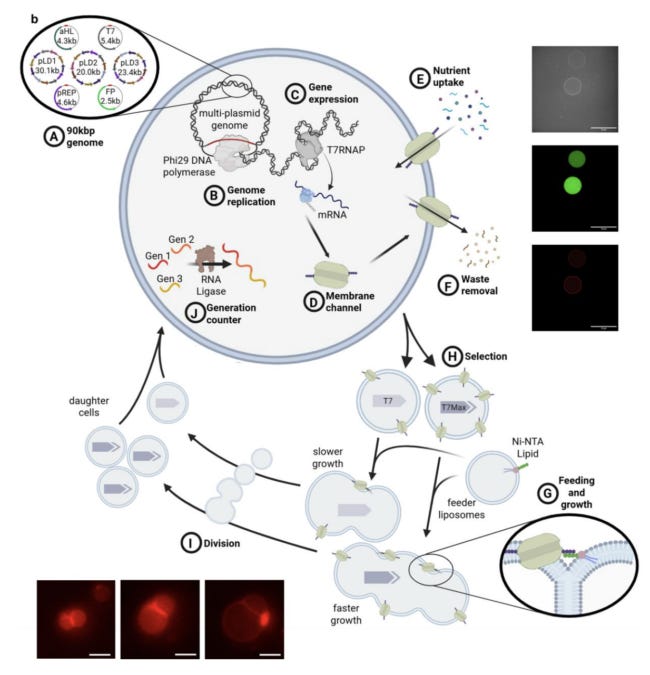
SpudCell is built around several major modules.
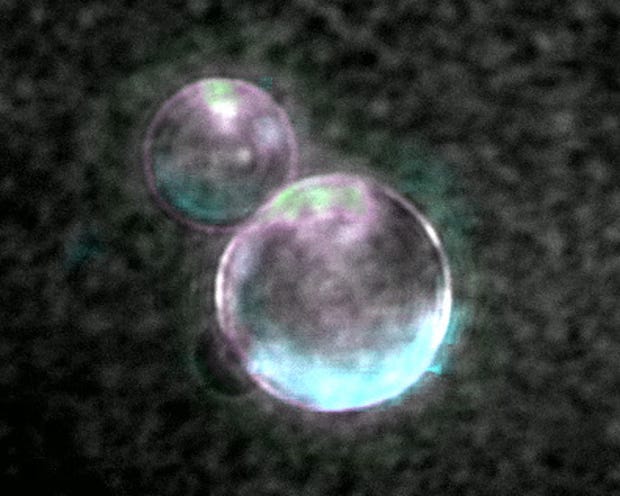
First, it has a liposome membrane, a lipid compartment that gives the system a cell-like boundary.
Second, it contains a roughly 90kb multipartite genome. The manuscript describes synthetic cells as liposomes containing DNA encoded across multiple plasmids, plus an in vitro protein-expression system. The public project materials count the architecture slightly differently depending on whether they are referring to plasmid modules or all DNA molecules, so the safest professional wording is: a roughly 90kb multipartite genome.
Third, SpudCell uses a cell-free protein-expression system. The manuscript distinguishes between TxTl, a whole-cell-extract-based system used in early feeding tests, and PURE, a chemically defined translation system used for the main cell-cycle, selection, competition, and division experiments. PURE matters because its components are purified and known, making the system more controllable than crude biological extract.
Fourth, SpudCell uses Phi29 DNA polymerase to copy its DNA. In the manuscript, Phi29-mediated replication is used to amplify the plasmids that make up the synthetic genome.
Fifth, SpudCell depends on feeder liposomes. These vesicles supply lipids, enzymes, ribosomes, small molecules, and other resources. This is one of the most important caveats: SpudCell does not yet make everything it needs. The Guardian reports that SpudCells grow by fusing with feeder liposomes that contain molecules, enzymes, and ribosomes needed for protein synthesis. (The Guardian)
So SpudCell is not autonomous life.
It is a controlled platform for testing how far life-like behavior can be reconstructed from defined components.
The central trick: the genome controls feeding
The most elegant part of SpudCell is not simply that it “feeds.”
It is that feeding is linked to gene expression.
Natural cells grow by taking in nutrients, metabolizing them, building new molecules, expanding their membranes, and dividing. SpudCell cannot yet do that independently. Instead, the researchers engineered feeding through liposome fusion.
The key protein is alpha-hemolysin, written as αHL.
SpudCell expresses a modified αHL membrane protein from its own DNA. This protein presents a tag on the synthetic cell surface. Feeder liposomes carry matching Ni-NTA lipid tags. When the two interact, the synthetic cell and feeder liposome fuse. That fusion supplies membrane lipids and replenishes internal molecular machinery.
The manuscript reports that His-tagged αHL paired with Ni-NTA lipids induces liposome fusion, and because αHL is expressed inside the synthetic cell, the feeding mechanism depends on a genome-encoded protein.
That is the conceptual leap.
The cell-like system is not merely being passively inflated by researchers.
Its genome affects how well it feeds.
Once growth depends on genotype, selection becomes possible.
A synthetic cell cycle, not just a synthetic compartment
A liposome alone is not a cell.
DNA inside a vesicle is not enough either.
The strength of this manuscript is that it links several behaviors into a repeated cycle: feeding, membrane growth, genome replication, gene expression, division, and inheritance.
The multi-generation experiments are especially important. The synthetic cells were fed with resource-containing liposomes, incubated, divided, then transferred into fresh feeders for the next generation. The authors report newly synthesized DNA after successive generations when Phi29 replication was present, along with mRNA and protein expression. They also used a generation-counter system to show that the same synthetic-cell lineage had fused with feeder liposomes across repeated rounds.
One of the strongest results is that, after five generations, about 30% of analyzed cells contained the complete set of seven plasmids from the 90kb genome. That is not perfect inheritance, but it is meaningful because SpudCell lacks the cytoskeleton and genome-segregation machinery that natural cells use to distribute chromosomes and cellular contents.
This is the right way to understand the result:
SpudCell does not yet reproduce like a bacterium.
But it shows that a chemically defined system can maintain a cell-like cycle across multiple generations under controlled laboratory conditions.
That is a major step.
Selection is the strongest biological signal
The most interesting part of the manuscript is not just growth or division.
It is selection.
The researchers engineered a genetic difference in the promoter controlling αHL expression. One version used a regular T7 promoter. The other used a stronger T7Max promoter. Because αHL controls feeding, stronger αHL expression should improve fusion with feeder liposomes, increase growth, and produce more offspring.
That is what the experiments showed.
Cells with stronger αHL expression fused more efficiently, grew more effectively, and gained population share over multiple generations. In one set of experiments, the weaker population fell from an initial 50% to around 34%, while the stronger T7Max population rose to around 58%. Sequencing supported the same direction: when T7Max began at 50%, it reached about 61% after five generations, and when it began at only 10%, it rose to about 38%.
This matters because it connects genotype to phenotype to reproductive success.
A genetic difference changed feeding.
Feeding changed growth.
Growth changed offspring number.
Offspring number changed population structure.
That is selection.
But the caveat is essential: this is not open-ended Darwinian evolution yet. The beneficial variant was introduced by the researchers. The manuscript explicitly states that the next step would be enabling spontaneous mutations to arise inside the synthetic cells and then be acted on by selection.
So the strongest accurate claim is:
SpudCell demonstrates selection on an introduced beneficial variant, not spontaneous evolution yet.
That is still a serious milestone.
Competition makes the system more life-like
The manuscript also tests competition under resource limitation.
This is important because life does not operate in unlimited abundance. Cells compete for nutrients, space, energy, and survival advantage. If a synthetic cell-like system can show stronger selection under scarcity, that makes the behavior more biologically meaningful.
The researchers mixed faster-growing T7Max αHL cells with slower-growing T7 αHL cells, then reduced feeder-liposome availability. Under normal feeding, the faster-growing cells already gained an advantage. Under the most resource-limited condition, fast-growing cells reached around 70% of the population compared with about 29% for slow-growing cells in the reciprocal marker condition. qPCR measurements of newly synthesized DNA supported the flow-cytometry results.
The conclusion is simple:
When food becomes scarce, the better feeder wins harder.
That is a primitive ecological behavior inside a synthetic chemical system.
Not a living ecosystem.
But an engineered system showing a recognizable logic of biological competition.
Division without a natural cytoskeleton
Cell division is one of the hardest problems in bottom-up synthetic-cell engineering.
Natural cells do not simply split because they get bigger. They use organized molecular machinery. Bacteria, yeast, and animal cells all rely on cytoskeletal or cytoskeleton-like systems to coordinate division, distribute contents, and produce viable daughters.
SpudCell does not yet have a functional cytoskeleton.
Instead, the researchers used membrane physics. The synthetic cells express tagged αHL, then external linker molecules and streptavidin attach to the membrane surface. This creates protein crowding, which induces membrane curvature and helps split the compartment.
The manuscript reports that daughter-cell DNA was detected when the required division elements were present, and that stronger αHL expression produced more daughter-cell signal than weaker αHL expression in competitive division conditions. It also reports that growth and division could be combined, with daughter-cell fractions containing genome material after DNA replication, feeding, and division.
The University of Minnesota summary highlights this as a major advance because SpudCell bypasses the cytoskeleton bottleneck using proteins that crowd on the membrane surface until mechanical stress makes the membrane split. (University of Minnesota Twin Cities)
This is not natural-quality division.
It is lower yield, less controlled, and still externally assisted.
But it demonstrates that genome-linked molecular events can drive physical reproduction in a synthetic cell-like system.
How the authors validated the claim
A strong interpretation of this manuscript cannot rely only on the headline. The validation package matters.
The authors used DpnI digestion so that DNA measurements preferentially reflected newly synthesized DNA rather than original input plasmid. Newly synthesized DNA was detected when Phi29 replication was present. They used generation counters to track repeated feeding events across lineages. They used dialysis controls to remove feeder liposomes after each generation and reduce the possibility that old feeders were carrying the signal forward. They tested leakage and reported no detectable loss of large internal molecules such as plasmid, mRNA, or ribosomal RNA after five generations.
They also used multiple readouts rather than one convenient measurement: fluorescence, qPCR, RT-qPCR, flow cytometry, sequencing, microscopy, single-cell plasmid quantification, membrane mixing assays, lumen mixing assays, and parent-daughter fraction assays.
The selection experiments had additional controls. The authors checked whether T7 and T7Max plasmids differed in Phi29 replication yield and report no significant difference, arguing that the observed population shift was not simply caused by one plasmid being amplified faster. They also tested metabolic load by comparing fluorescent markers of similar size, because reporter expression itself can burden the fragile synthetic-cell metabolism.
That does not mean every claim is final.
It means this is not a one-readout story.
The manuscript presents a broad experimental package designed to support the central claim from multiple angles.
What remains unsolved
The limitations are not footnotes. They define what SpudCell is.
First, SpudCell is not fully autonomous. It depends on feeder liposomes and a chemically rich environment. The Guardian notes that SpudCells remain dependent on their environment and cannot yet control metabolism or waste clearance like living cells. (The Guardian)
Second, it cannot yet make its own ribosomes. Ribosomes are the molecular machines that translate RNA into protein. The manuscript states that the synthetic cells have very limited metabolism and cannot make ribosomes, and that complete metabolic independence will require more work.
Third, genome inheritance is imperfect. About 30% of analyzed cells contained the complete plasmid set after five generations. That is impressive for a system without natural segregation machinery, but it also shows that most daughter cells did not inherit a complete genome set.
Fourth, division is still early-stage. The genetically encoded division mechanism is clever, but it is not as robust or controlled as natural cell division. The manuscript says future work will need better mechanisms for cytoplasmic and genome segregation, likely including more advanced synthetic cellular organization and perhaps synthetic cytoskeletal systems.
Fifth, selection is not spontaneous Darwinian evolution yet. The advantageous variant was introduced artificially. True Darwinian evolution would require mutations to arise inside the cells and then be selected over generations.
Sixth, the work is still a manuscript/preprint, not a peer-reviewed journal publication yet. The Guardian reports that the study was released as a preprint before peer review so other labs could scrutinize it, and Quanta also identifies the study as not yet peer-reviewed. (The Guardian)
None of these caveats dismiss the work.
They make the milestone precise.
SpudCell is not the endpoint of synthetic life.
It is a major beginning.
Why the 90kb genome matters
The genome size is one of the most interesting details in the project.
The manuscript notes that previous analysis speculated that a minimal genome for a living cell could be around 113kbp, while SpudCell uses a roughly 90kb genome. The University of Minnesota summary also highlights that SpudCell’s genome is smaller than that speculative threshold and is modular rather than a single chromosome. (University of Minnesota Twin Cities)
But this should not be misread.
A 90kb genome here does not mean 90kb is enough for autonomous life.
Why?
Because SpudCell outsources many hard biological tasks.
It does not run a complete self-sustaining metabolism.
It does not build its own ribosomes.
It receives enzymes, ribosomes, lipids, and small molecules from feeder liposomes.
Its inheritance is incomplete.
Its division mechanism is still primitive.
So the 90kb genome is not a complete recipe for independent life.
It is better understood as a compact control genome for a supported synthetic cell-cycle platform.
That is still scientifically powerful because it lets researchers ask which life-like behaviors require a full natural cell, which can be rebuilt from modules, and which only emerge when those modules are coupled.
Why this is not “just a blob”
A skeptic could look at SpudCell and say: it is just a vesicle.
But that misses the point.
A liposome alone is just a compartment.
DNA alone is just information.
PURE alone is just a translation reaction.
Phi29 alone is just a replication enzyme.
Feeder liposomes alone are just supplies.
Protein crowding alone is just membrane physics.
SpudCell matters because it connects these modules into a repeated cycle.
Information affects feeding.
Feeding affects growth.
Growth affects division.
Division affects offspring number.
Offspring number affects selection.
That is the conceptual breakthrough.
Quanta describes the work as a major step toward making a living system from nonliving components, while also emphasizing that the system is not completely there yet. The Guardian similarly frames it as a step toward synthetic life, while noting that SpudCells remain dependent on their environment and cannot yet perform many functions like living cells. (Quanta Magazine)
That is the right balance.
Not alive yet.
But far beyond an inert droplet.
Why this could matter
SpudCell matters for three big reasons.
First, it gives researchers a new way to study minimal life. Natural cells are too complex to fully explain from first principles. A chemically defined synthetic cell-like system lets scientists test which components are necessary for cell-cycle behavior.
Second, it could become an engineering chassis. A defined synthetic cell would be more modular than a natural cell. Researchers could swap genes, enzymes, pathways, or molecular systems and measure what changes without the hidden complexity of a living organism. Biotic frames the project as shared infrastructure for synthetic cell engineering, with the long-term goal of making biological systems more programmable and understandable. (biotic.org)
Third, it helps bridge chemistry and biology. SpudCell is not an origin-of-life reconstruction in the strict historical sense, because it uses modern biological molecules and purified machinery. But it gives researchers a controlled way to ask how nonliving components can be organized into life-like cycles.
That may be its deepest value.
It turns “What is life?” from a purely philosophical question into an engineering experiment.
The safety question
This is not a reason to panic.
SpudCell is fragile, externally supported, and dependent on carefully controlled laboratory conditions. It does not look like something that could survive outside its engineered environment.
But the long-term governance question is real.
As synthetic cells become more autonomous, more robust, and more evolvable, the field will need strong standards around containment, reproducibility, misuse prevention, transparency, licensing, and public oversight. The University of Minnesota summary notes that Biotic is being launched as a public-benefit institution to build shared infrastructure for synthetic cell engineering. (University of Minnesota Twin Cities)
The concern is not SpudCell escaping today.
The serious issue is the trajectory SpudCell opens.
The best anti-hype framing
The headline “scientists created life” is too strong.
But the dismissive framing is also wrong.
This is not “just chemistry.”
It is chemistry organized into a cell-like cycle.
The most accurate version is:
SpudCell is a bottom-up, chemically defined synthetic cell-like system that can feed, grow, copy DNA, divide, and undergo selection across generations, but it is not yet a fully autonomous living organism.
That sentence captures the science.
Supportive.
Precise.
No hype.
Common Questions About SpudCell
Did scientists create life from scratch?
Not in the full autonomous sense. SpudCell is a bottom-up synthetic cell-like system built from known chemical components, and it performs several life-like behaviors, including feeding, growth, genome replication, division, selection, and competition. But Biotic’s own FAQ says SpudCell still cannot sustain itself without outside help.
Is SpudCell alive?
The safest answer is: not fully. It behaves like a primitive synthetic cell cycle, but it is far simpler than natural cells and remains dependent on supplied components and controlled lab conditions. Biotic says it depends on external feeding and tightly maintained temperature, pH, and salt levels.
How does SpudCell feed?
SpudCell grows by fusing with feeder liposomes. These feeder liposomes deliver lipids, enzymes, ribosomes, and small molecules. The important part is that fusion is controlled by a protein SpudCell makes from its own DNA, linking feeding to the genome.
Does SpudCell evolve?
Not in the open-ended Darwinian sense yet. The system shows selection and competition, but the beneficial genetic change was introduced by researchers rather than arising spontaneously inside the synthetic cells. That distinction is essential.
Why is this not just a droplet with DNA?
Because the parts are connected into a cycle. DNA expression affects feeding, feeding affects growth, growth affects division, and division changes offspring number. That coupling is what makes SpudCell more important than a passive vesicle.
Can SpudCell survive outside the lab?
No. Biotic says SpudCell cannot survive outside controlled laboratory conditions because it requires regular external feeding, precise temperature, pH, and salt levels, and has no defenses against environmental stress or contamination.
Has this been peer-reviewed?
Not yet. Biotic says the work is being released as a preprint, with peer review underway at a journal. That should be stated clearly so the article stays scientifically careful.
The real breakthrough
The real breakthrough is not that researchers created a new bacterium.
They did not.
The real breakthrough is that researchers reconstructed several core behaviors of the cell cycle without starting from a living cell.
A lipid membrane.
A defined protein-expression system.
A compact multipartite genome.
Phi29-based DNA replication.
Genome-controlled feeding through αHL.
Feeder liposomes supplying resources.
Growth through membrane fusion.
Division through protein-driven membrane mechanics.
Selection through a genetic variant that improves feeding and reproductive output.
That is a serious synthetic-biology milestone.
SpudCell is not fully alive.
But it shows that life-like behavior can be assembled from parts.
For centuries, life looked like a boundary: chemistry on one side, biology on the other.
SpudCell suggests that boundary may be engineerable.
Not crossed completely.
But approached, module by module.
We are watching chemistry begin to imitate the cell cycle.
And that may be the beginning of a new era in synthetic biology.
Sources and further reading
Source note: This article is based on the SpudCell manuscript/preprint, the Biotic project page, and current reporting. The work has not yet completed peer review.